
Ezimill Series
Ezimill Intuitive Touch Smart Mill
Three series — otomat, Ezimill and Ezimill+ — from conventional-mill upgrades and single-process automation to graphic-dialog multi-process machining, with intuitive touch control spanning molds, large workpieces and precision parts.
Made in Taiwan
Compare
Series at a glance
| otomatConventional | EzimillSingle-Function | Ezimill+Advanced | |
|---|---|---|---|
| Positioning | Entry · conventional upgrade | Single-process auto | Advanced · multi-process |
| Control Screen | 7" (opt. 10.4") | 10.4" | 10.4" |
| Operation | Conventional mill + axial servo | Graphic single-process auto | Graphic single/multi-process auto |
| Machining | Facing · slots · drilling | + polygon pockets · islands | + up to 10 linked sequences |
| Best for | Manual-mill upgrade | Single-process work | Multi-process work |
| Models | OT-1A / OT-2A / OT-3A / OT-4A / OT-5A / OT-6A6 models | SM-4AL / SM-300AH / SM-800H / SM-1000H4 models | SM-450H / SM-650H / SM-1654H / SM-2063H / SM-2473H5 models |
Intuitive Touch
Draw it, machine it — no G/M code
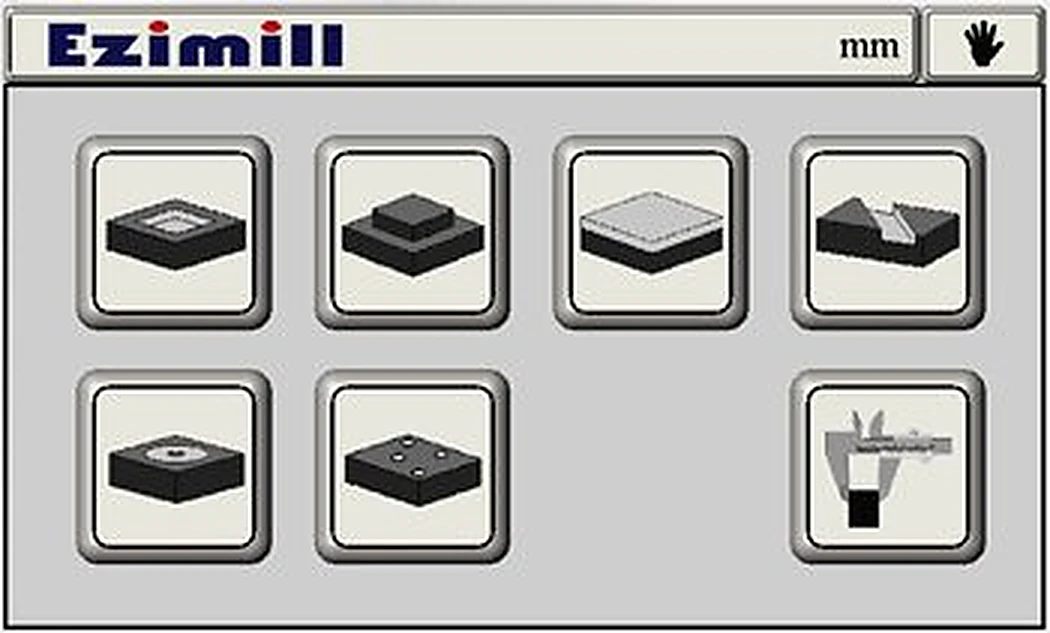
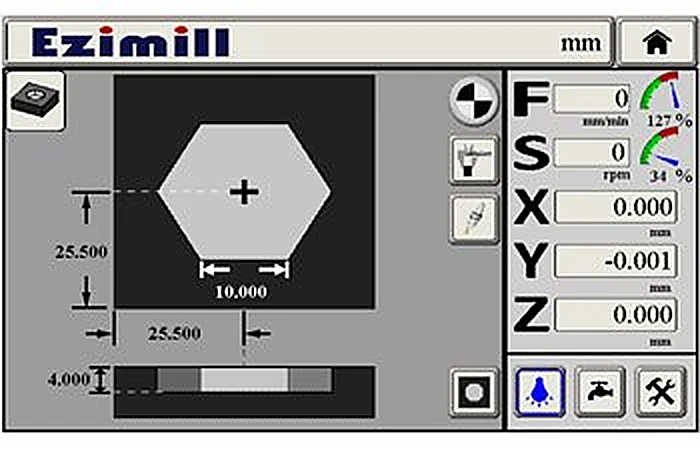
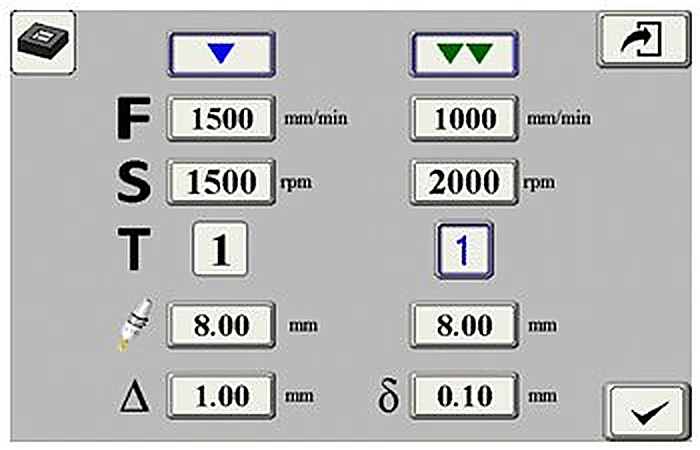
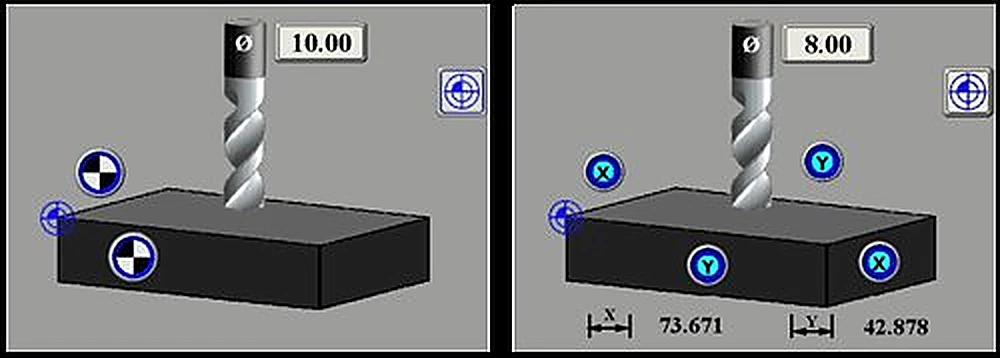
Built on a traditional machine-tool structure with a drawing-based touch interface, common milling functions are modularized. No complex G/M code or CAD/CAM — operators handle polygon pockets, islands, facing, slots, boring and drilling modules, with guided edge-finding for origin setup.
MODULES
Machining Modules
OPERATION
Operation Screens
Videos
Visit channelFAQ
Frequently Asked Questions
Common questions about conversational and intuitive milling machines.
What is a conversational milling machine, and how does it differ from a traditional CNC mill?
A conversational milling machine is a CNC mill that needs no G/M code. The operator enters machining parameters in on-screen table fields via the keypad, and the controller generates the program from those values. Compared with a traditional CNC mill requiring G/M code or CAD/CAM, conversational operation greatly lowers the programming barrier.
What is the difference between an intuitive mill and a conversational mill?
Both eliminate G/M code. A conversational mill enters parameters through keypad-and-table fields. LIHAITEC's Ezimill Intuitive Touch Smart mill uses planar (2D) graphical operation: you select and place machining modules on a 2D plane drawing, then set the Z-axis depth, and the system automatically detects the graphics and generates the toolpath — more visual, with a lower learning curve. Some machines are also marketed as 'intuitive conversational' - the test is the same: where the toolpath comes from, values a person types into fields or graphics the system detects and turns into a path.
What is a teach-in mill, and how does it differ from the LIHAITEC Intuitive Touch Smart mill?
A teach-in mill records the motions and positions an operator demonstrates and plays them back, which presupposes someone who can already produce the part by hand, and changing a single dimension usually means teaching it again. LIHAITEC's Ezimill Intuitive Touch Smart mill does not rely on demonstration: select and place machining modules on a 2D plane drawing, set the Z-axis depth, and the system automatically detects the graphics and generates the toolpath. To change a dimension you change the number on the drawing - there is nothing to re-teach. Saved machining graphics, conditions and origin can be recalled for full-auto repeat production.
How is an intuitive mill different from a traditional CNC mill?
A CNC mill gives you the cutting capability, but turning that into a finished part still relies on someone writing G/M code or operating a computer-aided drawing system (CAD/CAM). Yet 'aided' is only aided — if the operator lacks the ability to draft and convert the code, the system cannot fill the gap: the drawing still does not get made and the program still does not get generated. It is like handing ingredients to a chef — a different cook yields a different result. LIHAITEC's Ezimill Intuitive Touch Smart mill removes that barrier: just read the drawing, select and place machining modules on a 2D plane drawing and set the Z-axis depth, and LIHAITEC's in-house smart control system automatically detects the graphics and generates the toolpath — no G/M code, no CAD/CAM. The same drawing and conditions produce a consistent path regardless of the operator's programming ability, lowering the requirement from 'able to program' to 'able to read a drawing', and giving traditional shops an on-ramp to smart machinery and smart manufacturing.
How does the LIHAITEC Intuitive Touch Smart milling machine machine automatically without any programming?
On a 2D plane drawing you select and place machining modules and set the Z-axis depth, and the system automatically detects the graphics and generates the corresponding toolpath — no G/M code, no CAD/CAM. This automated machining capability is based on LIHAITEC Utility Model patent M670627 (Automated Machine Tool Controller) and is available today on current production models.
Do I need programming or CAD/CAM skills to operate an intuitive mill?
No. LIHAITEC's Ezimill Intuitive Touch Smart mill uses planar (2D) operation with no G/M code and no CAD/CAM. An operator with basic drawing-reading skills can quickly get productive across planar machining, drilling and pocketing modules. A machine is for machining parts — not for learning a programming language.
Does the intuitive controller require a specific language or text literacy?
No. The intuitive controller turns text-and-command operations into graphics and symbols — operators tap the drawing and set conditions through symbols rather than reading text commands. The graphical, symbol-based interface crosses language and literacy barriers, so operators of any native language or region can use it directly, and it spares exported machines the burden of multi-language interfaces.
How do intuitive mills and machining centers work?
LIHAITEC's Ezimill intuitive mill mainly provides planar (2D) machining modules: select a module and set the Z-axis depth to machine the part. The range spans entry to advanced models, including machining-center models — all with no G/M code, easing the move from a manual mill to CNC.
Can an intuitive mill run fully automatic, repeatable production?
Yes. Save the machining graphics, conditions and origin; recall the setup and run full-auto repeat production — no programming required, so it is not limited to one-off parts.
Can the Intuitive Touch Smart mill add a robotic arm for unmanned, high-volume production?
Yes. The machine can be fitted with a robotic arm and an automatic load/unload unit. Together with the saved machining graphics, conditions and origin, it handles loading, unloading and continuous machining automatically for lights-out mass production — full line automation with no programming.
Can LIHAITEC milling machines be custom-ordered to requirements?
Yes. LIHAITEC builds to order, configuring the machine to your machining range, modules and automation needs; with a robotic arm and automatic load/unload the line can run unmanned around the clock — 24 hours non-stop. Contact us for configuration and model selection.
What is an intelligent control system for machine tools, and what does it do on a milling machine?
An intelligent control system moves the question of where the toolpath comes from off the operator and into the control itself. A traditional CNC mill needs someone to write G/M code or generate the path in CAD/CAM; an intelligent control system detects the graphics and generates the toolpath automatically. The Ezimill Intuitive Touch Smart control system developed in-house by LIHAITEC Intelligent Control works this way: select and place machining modules on a 2D plane drawing, set the Z-axis depth, and set up planar machining, drilling and pocketing with no G/M code and no CAD/CAM. Save the setup and recall it for full-auto repeat production.