From Traditional to Smart Intuitive: the evolution of machine-tool operation and the return to the essence of machining
A machine tool is for making parts. What an operator wants is to get the part made — not to learn a programming language. For decades, the evolution of how we operate lathes and mills has been moving back toward that purpose, lowering the barrier step by step.
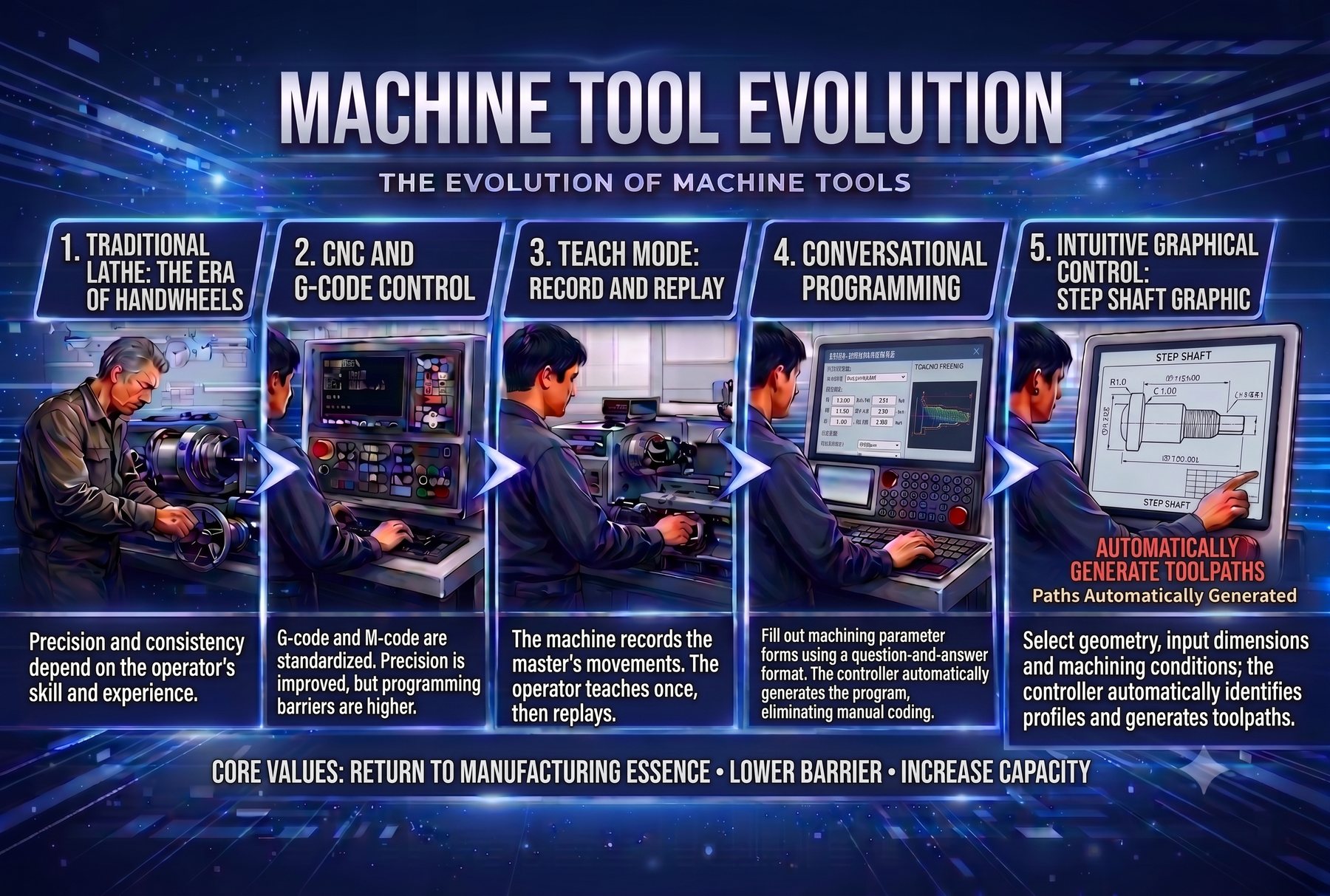
1.Traditional lathe: the age of the hand wheel
Precision and consistency tied to the operator’s touch and experience. The earliest lathes and mills relied entirely on the machinist’s handwheels — change the part or change the operator, and the result could change too.
2.CNC & G-code control
Precision increases, but the entry barrier also increases. From the 1950s, NC controlled tools via punched tape; in the 1960s G/M code (EIA/ISO) was standardized and, with computers, evolved into CNC — solving accuracy, repeatability and complex contours, and becoming the baseline of the modern machine tool. The trade-off: you had to write G/M code or run CAD/CAM — and the few who could program became the bottleneck on the line, one of the most painful parts of today’s labor shortage.
3.Teaching style: record and playback
Allowing the machine to “remember” the master’s movements. The record-and-playback idea behind teach-in appeared as early as the 1950s (contemporary with early NC) and carried through to today’s “teaching lathe”: the operator guides the machine through the motions once, and it records and replays — no hand-written program.
4.Conversational programming
Fill in tables with answers to machining questions via the panel’s keys. Conversational is a mode built into the CNC controller — in 1981, Mazak introduced the world’s first conversational CNC (MAZATROL, first seen on a lathe): using the many keys across the panel, the operator answers machining questions and fills in parameters field by field, and the controller generates the program — no hand-written G/M code. The barrier dropped another step — but it was still “keys and a form,” requiring you to break a part into a string of numbers in your head.
5.Smart Intuitive: lathe workpiece graphical control
No programming, low entry barrier, intuitive operation, automated and unmanned mass production. LIHAITEC’s smart-intuitive control — the Intuitive Touch Smart Lathe — goes a step further: the interface is no longer a panel of keys but intuitive touch, where the operator taps the machining point directly on the workpiece drawing on the touchscreen, and the system automatically detects the contour and generates the toolpath — no G/M code, no CAD/CAM. From “keys and a form” back to “read the drawing, tap it, machine it” — exactly how a machinist already thinks. This graphical-intuitive approach is carried by Utility Model M670628 (Intuitive Small Lathe), and its automated machining capability is based on M670627 (Automated Machine Tool Controller).
The return to the essence
The final destination is also the beginning: let machines be used for machining parts, not for learning programming languages. Code-free does not mean one-off only — save the machining graphics, conditions and origin for full-auto repeat production; add a robotic arm and automatic feeding for unmanned, around-the-clock output. From traditional to CNC, teaching, conversational and smart intuitive, the way we operate machine tools has come full circle — and the destination is the start: let anyone who can read a drawing make the part.