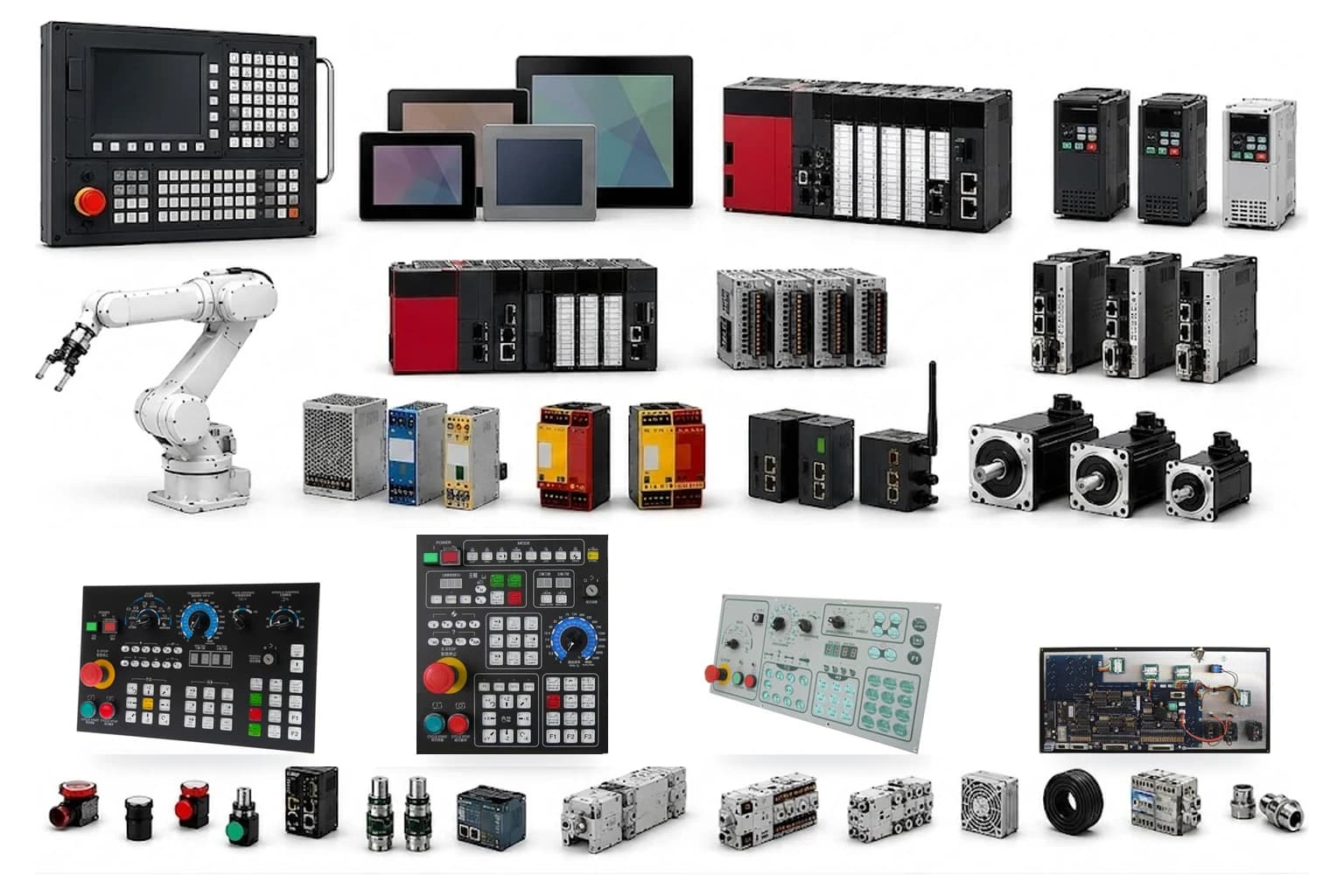
From CNC, HMI, PLC, servo motors, inverters and robotic arms to electrical-control parts, LIHAITEC provides a full range of components and one-stop integration to meet every automation need.
Common questions about intelligent control systems for machine tools, intuitive touch operation and code-free machining.
What is an intelligent control system, and how does it differ from a traditional CNC controller?
The control system is the brain of a machine tool. A traditional CNC controller faithfully executes the G/M code a person has written: the toolpath must first be worked out by hand or generated in CAD/CAM. An intelligent control system takes that judgement into the control itself - the operator supplies the shape to be produced, and the system automatically detects the contour and generates the toolpath. The difference is not cutting capability but where the toolpath comes from: one depends on the operator's programming skill, the other is generated by the control - the same drawing and the same conditions yield a consistent result.
What kind of intelligent control does LIHAITEC Intelligent Control build?
LIHAITEC develops the Eziturn / Ezimill Intuitive Touch Smart control system in-house: the operator taps the machining position on the touchscreen drawing and enters the dimension and machining condition, and the system automatically detects the contour and generates the toolpath - no G/M code, no CAD/CAM. This automated machining capability is based on Utility Model patent M670627 (Automated Machine Tool Controller), is not limited to one machine type, and serves both lathes and mills from the same system; it extends to machine status and utilization monitoring so managers can see what a machine is actually doing. LIHAITEC does more than build the control system: it also configures the machines and the overall solution that suit the machining requirement; the control system is commissioned together with the machine before shipment, so what arrives is a machine ready for production.
Does adopting intelligent control mean replacing the whole machine?
What LIHAITEC ships today is a complete machine - the Eziturn Intuitive Touch Smart lathe and the Ezimill Intuitive Touch Smart mill - with the control system and the mechanical structure commissioned together before shipment, which removes the integration risk between control and machine. It is not a retrofit of an old machine. What really gets upgraded is the way you operate: each machine keeps an electronic handwheel for manual operation like a traditional machine, so automatic and manual fine-tuning coexist and a veteran machinist does not have to give up the feel they know.
We cannot hire lathe or mill machinists and our veterans are retiring - does intelligent control help?
Where it helps is the hiring qualification. Traditionally, turning a drawing into a finished part needs someone who can write G/M code or operate CAD/CAM, and people who combine machining experience with programming skill have always been scarce. An intelligent control system takes toolpath generation into the control itself, so the operator only needs to read the drawing - the recruiting and training bar drops from 'able to program' to 'able to read a drawing'. The veteran machinist's role does not disappear: cutting conditions, tool selection and judgement still come from the shop floor, and because the machining graphics, conditions and origin a veteran sets up can be saved and recalled by a newcomer, that experience stays in the plant instead of leaving with the person. The machine also keeps an electronic handwheel for manual operation when needed.
Do I need programming or CAD/CAM skills to machine with an intelligent control system?
No. The Intuitive Touch Smart control system uses blueprint-style operation - read the drawing, tap the drawing, and the setup is done. An operator with basic drawing-reading skills is productive in about 2 hours to half a day. The interface is graphical and symbol-based rather than text-command driven, so operators of any native language can use it directly. Saved machining graphics, conditions and origin can be recalled for full-auto repeat production. A machine is for machining parts - not for learning a programming language.
How do intelligent control, smart machinery and smart manufacturing relate to each other?
Think of three layers. Intelligent control sits at the machine layer: the control system itself detects the graphics and generates the toolpath. Smart machinery sits at the equipment layer. Smart manufacturing sits at the plant layer - machine data online, utilization and scheduling. Most shops are stuck at the first layer: however new the machine is, if the toolpath still depends on someone writing a program, the operating barrier has not really come down. LIHAITEC starts at the control layer, lowering the qualification from able to program to able to read a drawing, and then connects upward to machine status and utilization monitoring.
Why does it matter whether the control system is developed in-house?
Machine tool control systems have long been held by a small number of overseas brands, leaving machine builders dependent on others for feature customization, lead time and cost, and pushing products toward sameness. Because LIHAITEC develops its control system in-house, functions can be adapted to the machine model and the customer, automation peripherals such as robotic arms and automatic feeders can be integrated, and local technical support and training are available - for a machine builder, that is one route to differentiation on top of the mechanical strength it already has.
Our shop is being handed to the next generation. How do we keep what the senior machinists know?
Keep the "how" in the system. The machining graphics, cutting conditions and work origin a senior machinist has set up can be saved; the next time the same drawing comes in they are recalled and the job repeats, so the know-how becomes something the shop reuses rather than something that leaves with a person. What the incoming operator has to learn is how to read a part drawing, not how to write G/M code or run CAD/CAM: tap the feature on the touchscreen, enter the dimension and the cutting conditions, and the system detects the contour and generates the toolpath automatically. The machine also keeps its electronic handwheel, so the hands-on way of working is still there alongside it.
From an owner point of view, what does intelligent control actually change in the shop?
Three things. Hiring: the requirement shifts from "can write G/M code or run CAD/CAM" to "can read a part drawing", and an operator with basic drawing-reading skills is productive in about two hours to half a day, which widens how the shop can staff and schedule. Repeat orders: the machining graphics, cutting conditions and work origin are saved, so the same drawing coming back is recalled rather than set up from scratch. Small-batch, high-mix work: a new drawing does not have to be turned into a program before the job can start - tap the feature on the touchscreen, enter the dimension and the cutting conditions, and set up from there.